Project 2: Research: Artists

Week 7A

With ideas from the previous week, I have researched into artists and their work that would inspire me before I moved on to making any further progress. The artists that caught my eye were Ronan and Erwan Bouroullec and Junya Ishigami.

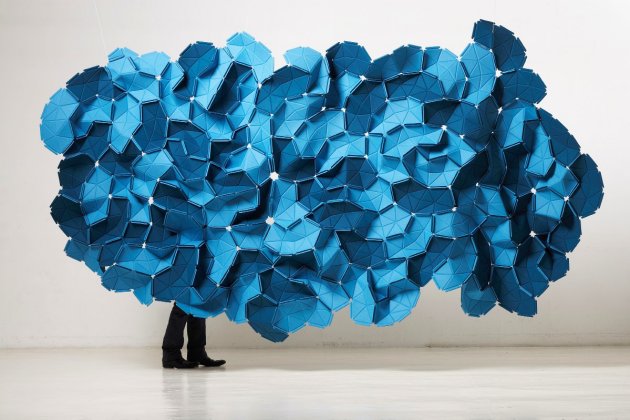
contemporist. (2009). Clouds by Ronan and Erwan Bouroullec [Image]. Retrieved from http://www.contemporist.com/clouds-by-ronan-and-erwan-bouroullec/

I thought Clouds by Ronan and Erwan Bouroullec was interesting in that the sculpture triggers curiosity. With some of their works being featured in front of display walls, it is difficult to guess what is behind the structure. One just has to take a guess, while multiple ideas pass through their mind. In order to highlight obscurity, I thought it would be a good idea to produce a patterned structure that covers part of the space, in order to give the viewers more creative room to imagine and explore the space.

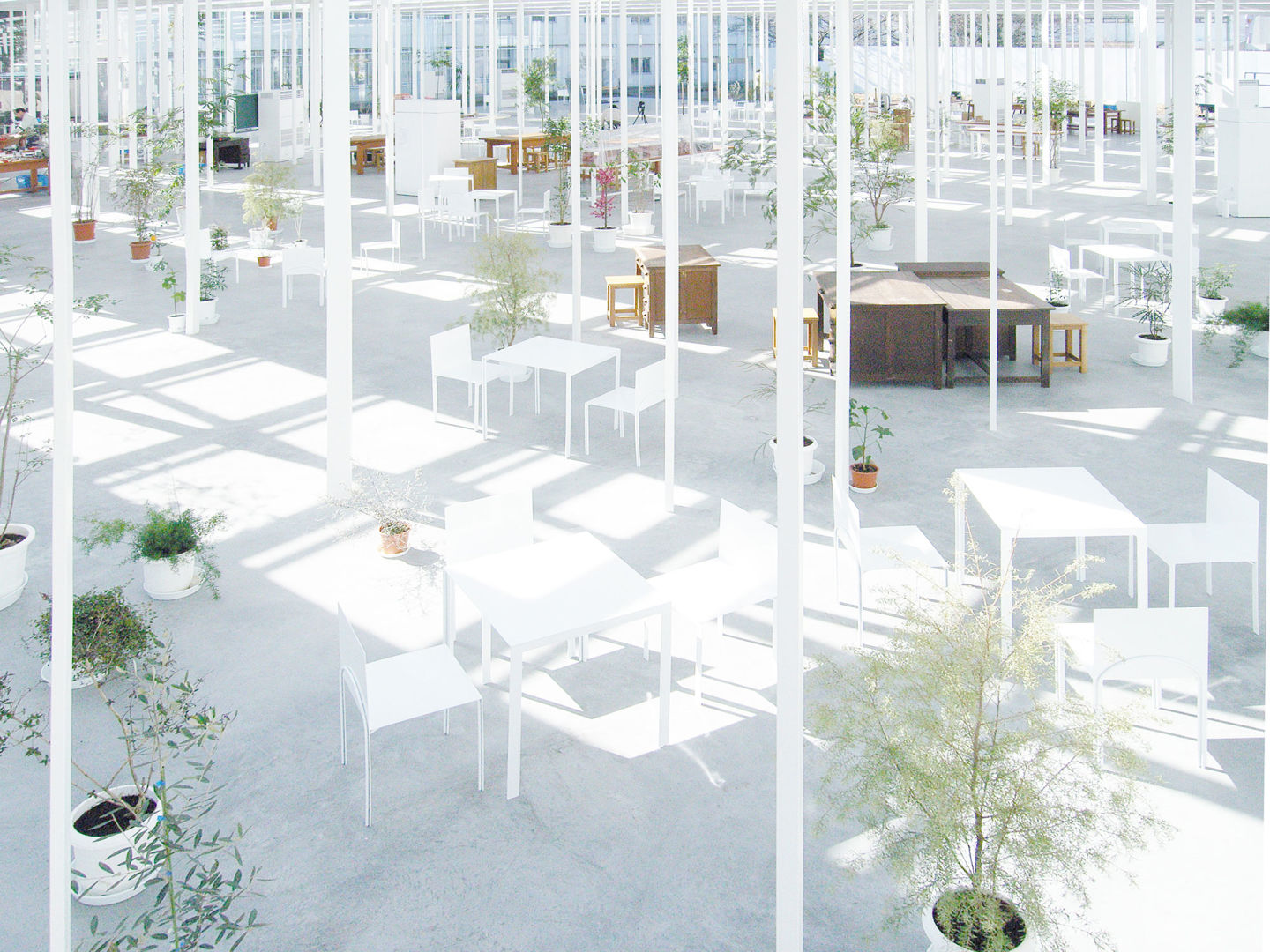
Archeyes. (2016). Junya Ishigami, Kanagawa Institute of Technology [Image]. Retrieved from http://archeyes.com/kanagawa-institute-of-technology-junya-ishigami-associates/

The design project of Kanagawa Institute of Technology by Junya Ishigami also caught my eyes in that the space looked like both an indoor and an outdoor space. Not only with the pots being placed throughout the area but also with white poles stretching out to their ceiling, reminding me of thin tree trunks. From the irregular placement of the pole, the space almost seems like a forest despite being an interior space.

Project 2: Site plan

Week 5-6

We visited the inside of the gallery space and were told to take measurements to draw a 1:50 site plan of the gallery, as well as spending time in the gallery to explore possible thresholds. The measurements were taken over a series of visits to the gallery. On the first day, we were in groups focusing on the measurements inside the gallery site. On the following visits, I have additionally measured the external elements of the eastern and northern facade, with some measurements in the lobby area and on the other floors. I have used the staircase to deduce the floor thickness between floors. The stairs were approximately 160mm high and there were 29 stairs from the lobby to the second floor (total height of 4640mm). With the highest part of the lobby being around 4000mm high, the estimated floor thickness was 640mm.

Photo of the shadow cast by the window taken around 12:00 pm

While taking measurements, I have visited the gallery on a regular basis to observe potential threshold I can further explore. One factor I found interesting was the light inside the gallery space. Not only the northern window cast a shadow of its frame during the daytime but also there was difference in temperature of the light depending on the time of the day. When I visited the gallery in the morning, the morning light made the gallery look rather cold and distanced. When I visited the gallery again in the afternoon, the afternoon light made the gallery seem more warm and welcoming.

Photo of the gallery taken around 9:30 am

Based on the measurements that were taken over time, an 1:50 A1 site map was produced.

1:50 A1 site map of the gallery

Project 2: Site Analysis III

Week 4 Sat 23/03/19

Individual site analysis was created based on the site analysis done as a group. I wanted to further explore the idea of obscurity and openess of the site.

Idea brainstorming

While brainstorming the key concepts, I decided to focus on the flora, inspired by Albert park, and level of the ground, which supports the idea of obscurity. Despite the park being surrounded by big trees on its peripheries, if the park was on low ground, the inside of the park may be more visible from higher grounds. However, in that the park is located in one of the higher grounds in the area, the interior of the park seems hidden from the outside of the park.

Tree drawing practice

The location of the park and the gallery is quite interesting – both are situated on high ground, almost on an equal level to each other, yet two locations are rather isolated from each other. Perhaps the sense of isolation elevated by the crossings in the middle of the two location and the flora around the park. From visiting the locations on foot, the bridge seemed like an important element that connects the two together.

Individual site analysis

In the site analysis I have created, I have used sketches I have made during the visit to the park and the gallery to outline key locations/views in both sites. Sketches of the flora was made based on the actual flora that is planted at the sites. The thick black line represents the ground level, that one has to either travel up or down. The thin black line represents the movement on the bridge connecting the two sites. The site analysis can be viewed both ways (can be reversed up and down) as the movement towards the site is not one directional.

The idea to represent structures relative to their physical level was inspired from the site analysis of Ian Athfield.


The Arts Foundation. Radical houses in Wellington by Ian Athfield [Image]. Retrieved from https://www.thearts.co.nz/artists/sir-ian-athfield#/ian-athfield-drawings-and-models

Project 2: Site Analysis II

Week 4 Wed 20/03/19

A1 site analysis was created based on personal research carried out from the beginning of the week.

Our group spent most of the time discussing about the threshold moment. Thus we lacked time to arrange our analysis layout. I think there is room for possible improvement and the session was also helpful in that I could make some developments of the key idea I had. The site analysis is centered around the map of Albert Park, with drawings and pictures placed around the map according to their actual location with respect to the park.

The threshold moment we explored was openness and obscurity. The two spaces, Albert Park and ST PAUL St Gallery Three, are both somewhat obscure in a way. The obscurity of Albert Park is enhanced by the location of flora. Due to the elevation of the park from ground level and the trees that are planted around the outer edge of the park, one cannot see the inside of the park from the outside.
Viewed from the inside, I thought the park looked like a chamber, as mentioned in the previous post. This makes the park like a private area, despite the park being a public space. However, there is a sense of openness to the park as well, considering the vertical element of the park. Only tall palms are planted in the center of the park, which allows the visitors to look up to the sky.

The obscurity of the gallery building is highlighted by light and its windows. The columns and the ceiling structure at the entrance cast shadow during daytime which to an extent makes the building look rather unapproachable. The windows on the front of the building adds onto the idea of obscurity in that some windows are not see-through, making the passers wonder the interior of the building. Even for myself, I have visited the gallery for the first time after walking past it for so many years, wondering what the inside of the building would be like. The inside of the building was rather dim and subtle. When the entire class walked in, the space felt more like a private, intimate space compared to the outside in that there were no space for people to disperse to. The space felt less opened than the park in that it was a closed space.

The bridge between two spaces is significant in that it connects the spaces together. While walking on the bridge, having those spaces in mind, you end up focusing on the exterior of the spaces. The bridge is simply a transition, from one to another, but is also a space where you can fully view their exterior. Just like the park, there was a tree planted next to the gallery which blocked out some part of the gallery when viewed at a certain angle from the bridge. However, after walking further down toward the park, I could have a clearer view of the gallery without having anything blocking its front. So the bridge in a way provides the viewers different exterior viewpoint for two spaces located close by as well. The walk on the bridge from the park to the gallery provides transition, from a somewhat private space, to a space that is more private and intimate in the interior.

Possible improvements to work on was also discussed, which I will take further when creating my individual analysis: What do boarders and screens in design represent? Do we want to emphasize such elements, or do we want to break them down? How would you effectively represent it? Would you use series of layers? How do your visuals communicate the narrative?
Project 2: Site Analysis I

Week 4 Mon-Tues 18-19/03/19

Introduction to quantitative and qualitative site analysis:

  • Quantitative : information we can research about the site
  • Qualitative : about condition/experience, applying “human essence”

Following two photos were taken on the over bridge that links Albert Park and Auckland University of Technology (AUT) that shows the views on the opposite sides. The bridge solely functions as a space for transition/movement that links spaces together.

View towards the site, ST PAUL St Gallery Three, shows two university venues and roads from the motorway. Viewed from the angle the photo is taken from, the venue is hided by the three that is planted next to the venue. There are barely any trees or other plants that hides the exterior of the building on the street opposite to the gallery.

The opposite view shows more of the park, with a lot more trees surrounding the park. The interior of the park is not quite visible from the bridge or from the outside of the park until one enters the park.

Sketches were made of some features of the park, including facilities, flora, natural light and level, exploring the connection between the park and the gallery.

Additional sketches were made after the visit inside the gallery building, around the area. I found the front of the building quite interesting in terms of the architectural style the building was built in – with the columns supporting the entrance of the building and multiple windows on the front (some not being able to see through).

Another visit was made the following day. The day was cloudy compared to Monday and it started raining when I walked into the park. The park was quite empty (perhaps due to the weather) thus the impression I got of the park was quite cold, somewhat solemn and serene. Walking towards the fountain, I thought the park resembled a chamber, with how the trees are planted within the park.

Project 1: Presentation

Week 3 Wed 13/03/19

Abstract

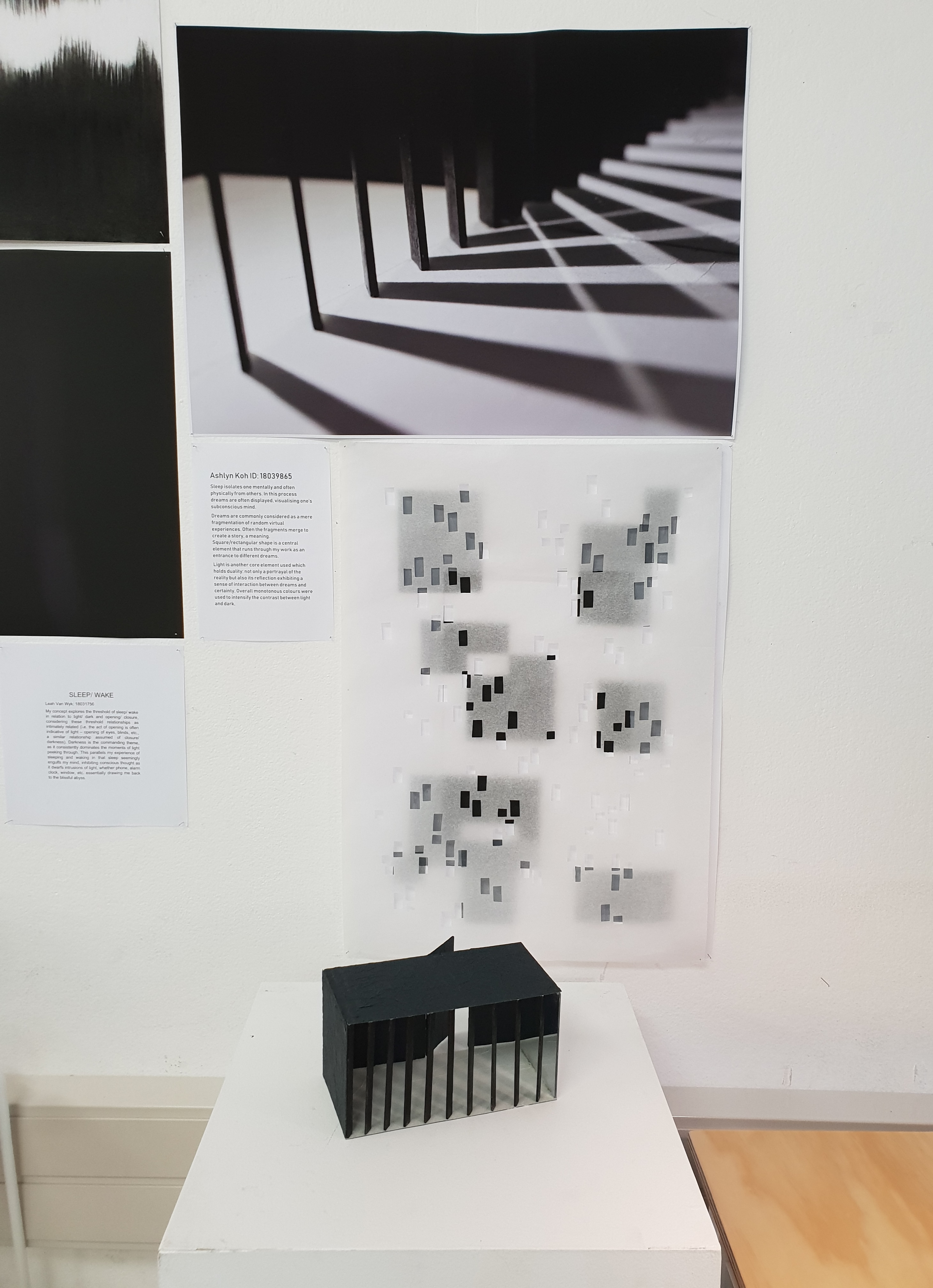
Sleep isolates one mentally and often physically from others. In this process dreams are often displayed, visualising one’s subconscious mind. Dreams are commonly considered as a mere fragmentation of random virtual experiences. Often the fragments merge to create a story, a meaning. Square/rectangular shape is a central element that runs through my work as an entrance to different dreams. Light is another core element used which holds duality: not only a portrayal of the reality but also its reflection exhibiting a sense of interaction between dreams and certainty. Overall monotonous colours were used to intensify the contrast between light and dark.

I wanted my works to be presented in a linear vertical manner so that my pieces harmonize with one another so that it resembles the linear shadows inside my model. The butter paper in front of the painting was slightly distanced from the wall and the painting in an attempt to give more of a three-dimensional effect as well as for the light to show through the cut outs. The model was placed in a slight angle to replicate the shadows from the photo. This was also achieved by placing a lamp next to the display to create a strong light source.

Project 1: Photography

Week 3 Mon 11/03/19

There were two potential images I wanted to create using my model:

  1. Contrast between light and dark
  2. Reflections on the mirror

Following images were taken to explore my model.

In that the main feature of my model was inspired from window blinds, I took a test shot in front of a blind-like exterior of the building. This photo, however, was lacking the elements mentioned above.

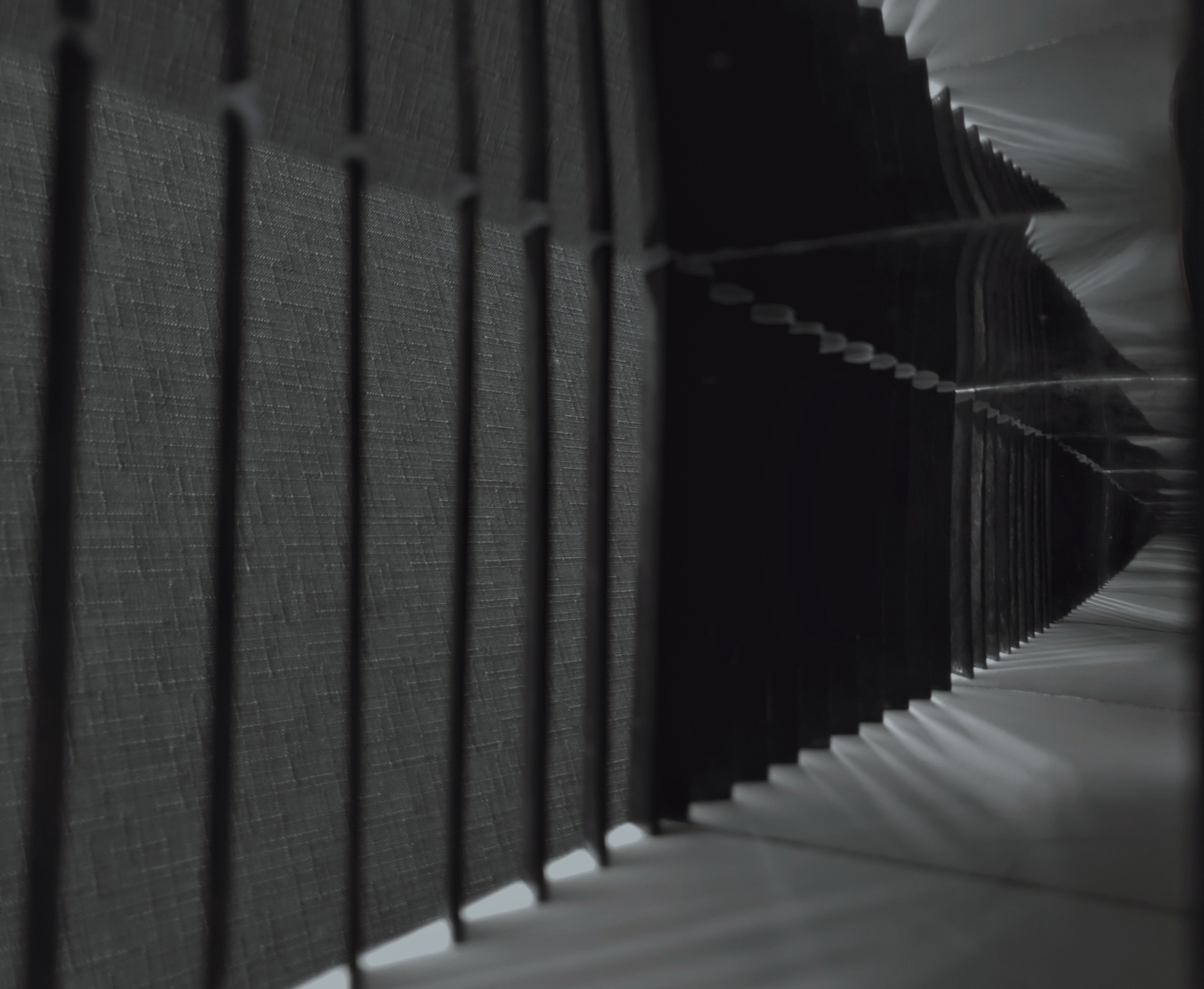
In terms of expressing the unlimited potential dream has, and the uncertainty that lies within, this image had the best representation of such concept. It was only possible for this image to be taken with a mobile device as the hinged doors were too small for the lens of the DSLR to fit through. The back plate was removed in an attempt to get a higher quality photo but it was difficult to achieve a shot with similar atmosphere as the lens was reflected on the mirror.

Final shot

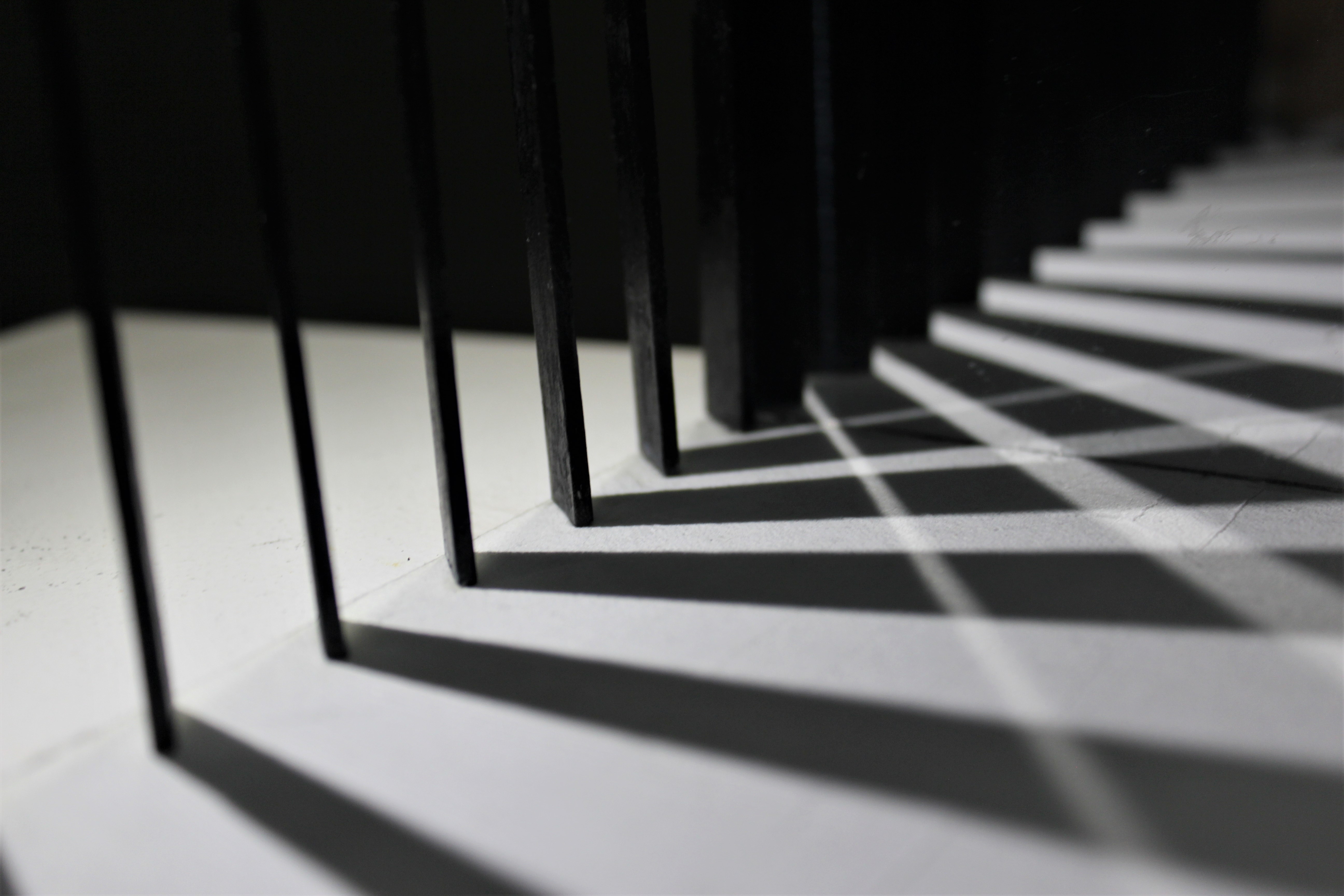
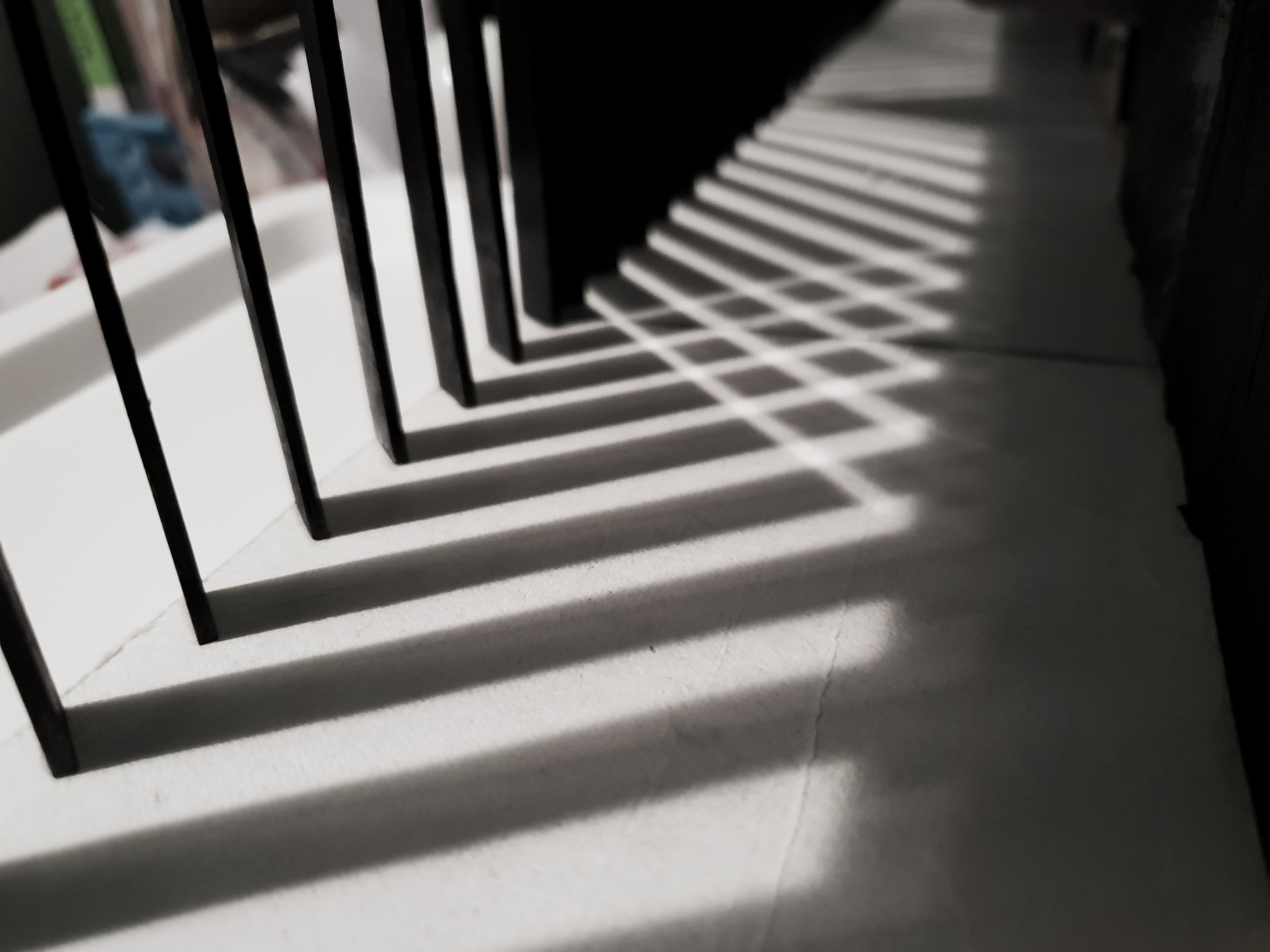
After the first few attempts at taking photos with different concepts, I decided to refer back to my very first test shot with strong light shining into the model. Multiple images similar to this shot was taken. In the decision process, photos without the lattice shadows were eliminated early on. Afterwards, the photo that best shows the contrast between light and dark were chosen. This photo was prioritized over others in that clear contrast is shown not only by the shadows created but also on the background of the model.

Project 1: Atmospheric Model Making III

Week 2 Sat-Sun 09-10/03/19

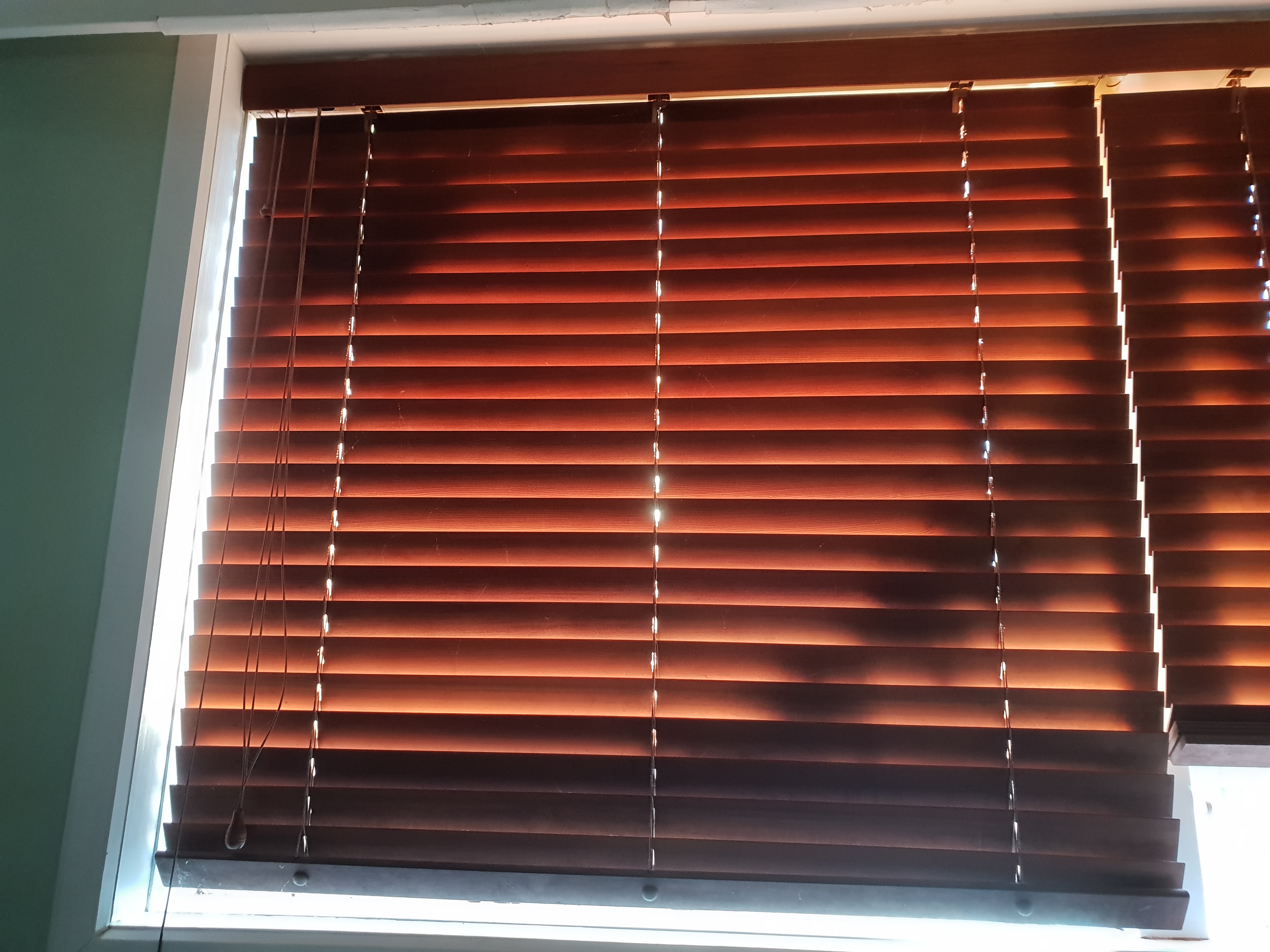
Whilst still trying to decide on the final design of the model, I was lying in bed until I saw rays of light being reflected on my wall through the small holes of my blind. This gave me the idea to replicate the shape of the blind and incorporate it into my model.

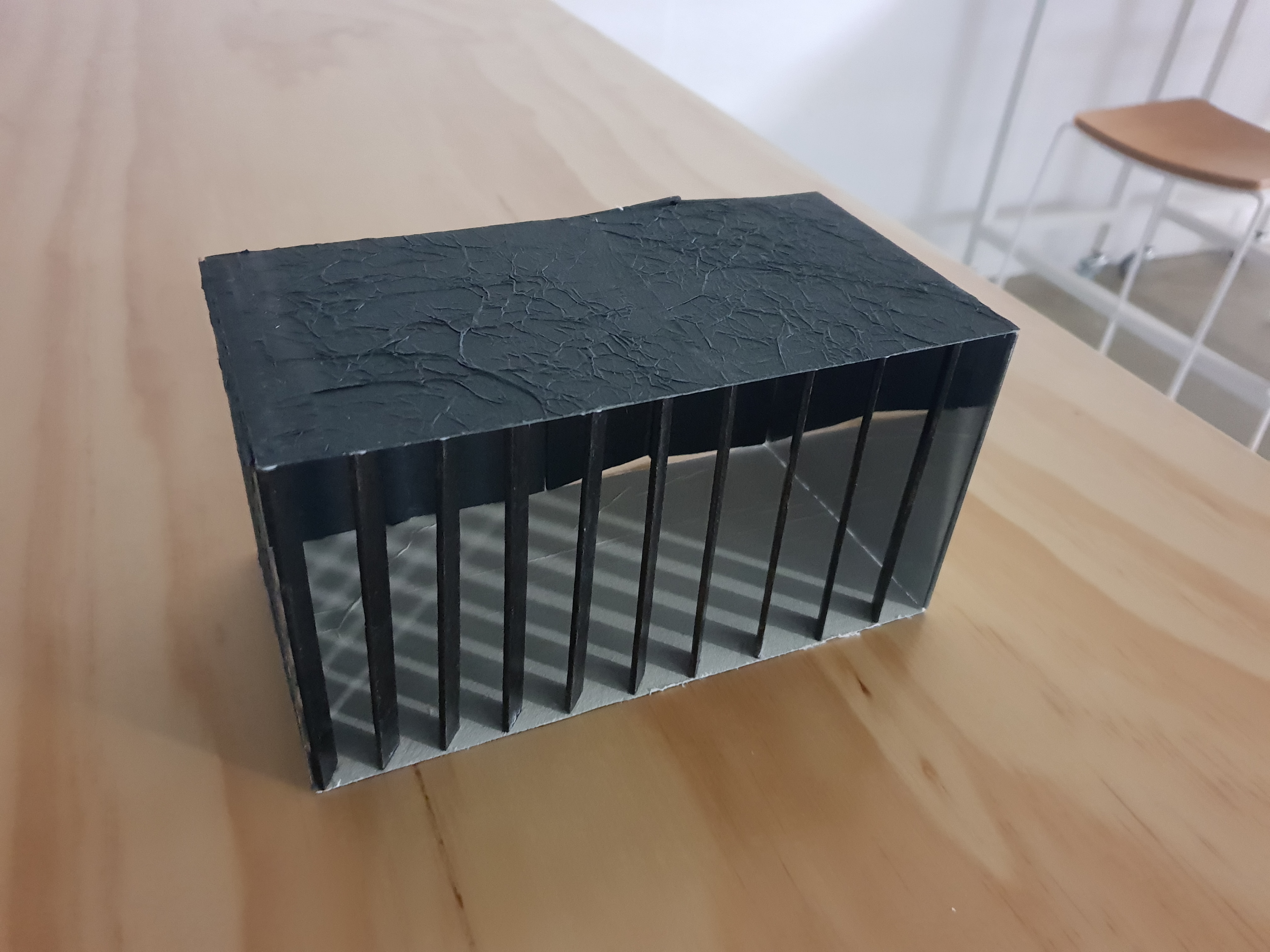
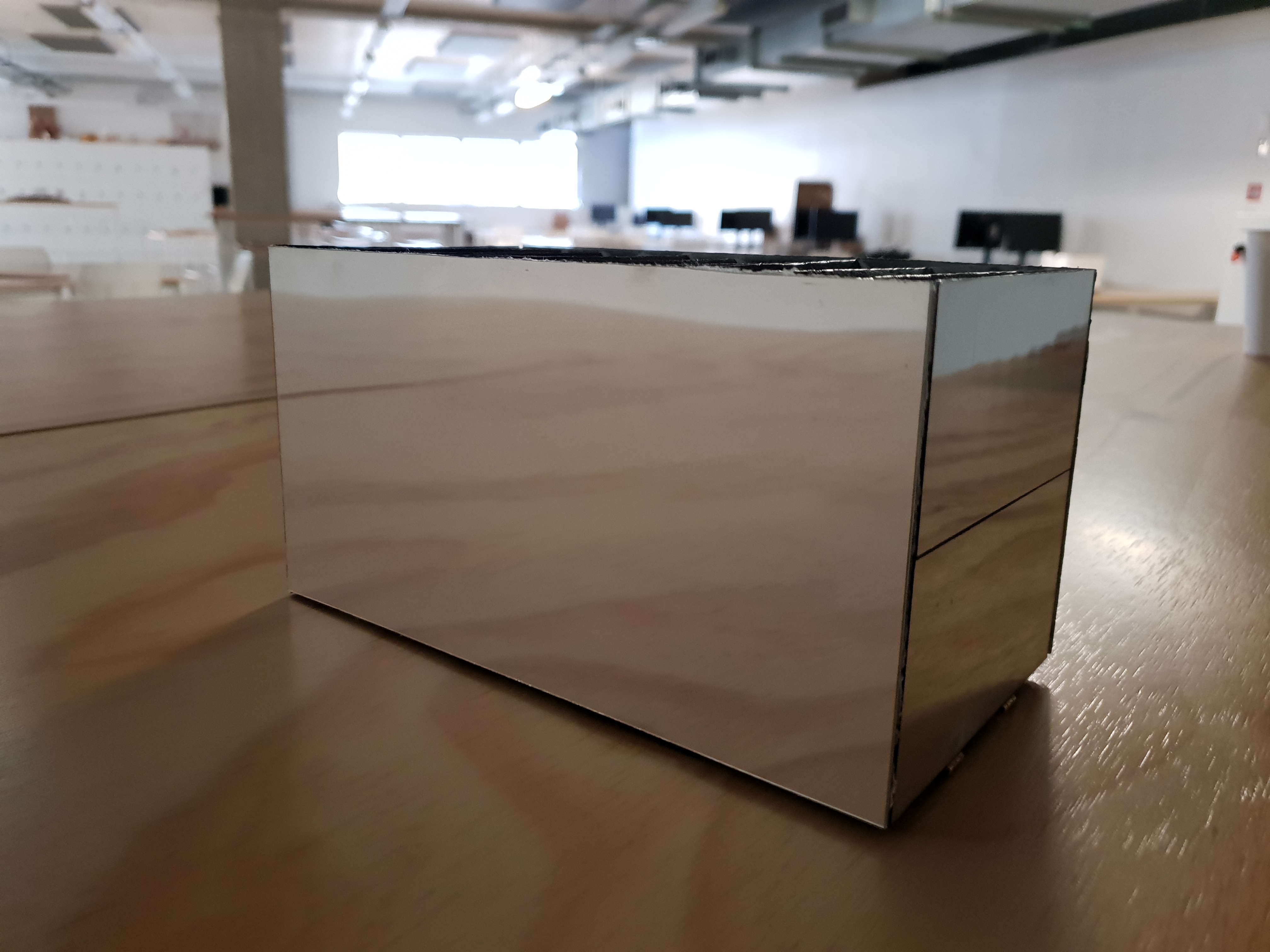
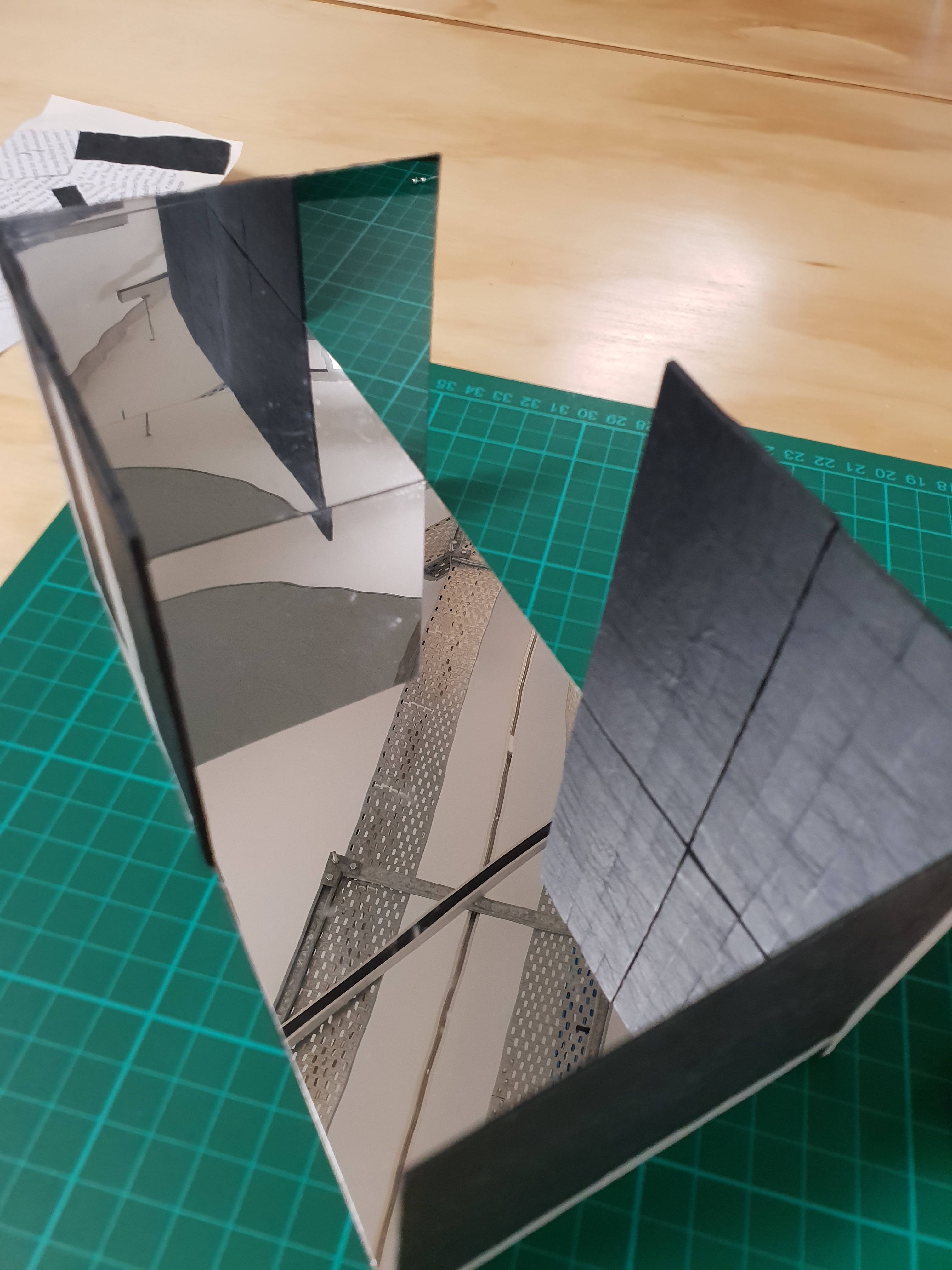
The model made has three mirror planes on the inside – one on each side and the ceiling. In order to clearly show the shadow being cast, the floor plane is covered with white tissue paper. Tissue paper was used to further provoke an image of the bed. The exterior covered with black wrapping paper except two sides that are covered with mirror planes.

The mirror planes almost merge the model with the surrounding – an idea that dream occurs within the boundaries of reality. Dream may not always be an exact representation of reality in that it offers more freedom. However, I believe they are based on experiences and information from reality. Hence I installed mirror planes on the exterior to present such idea.

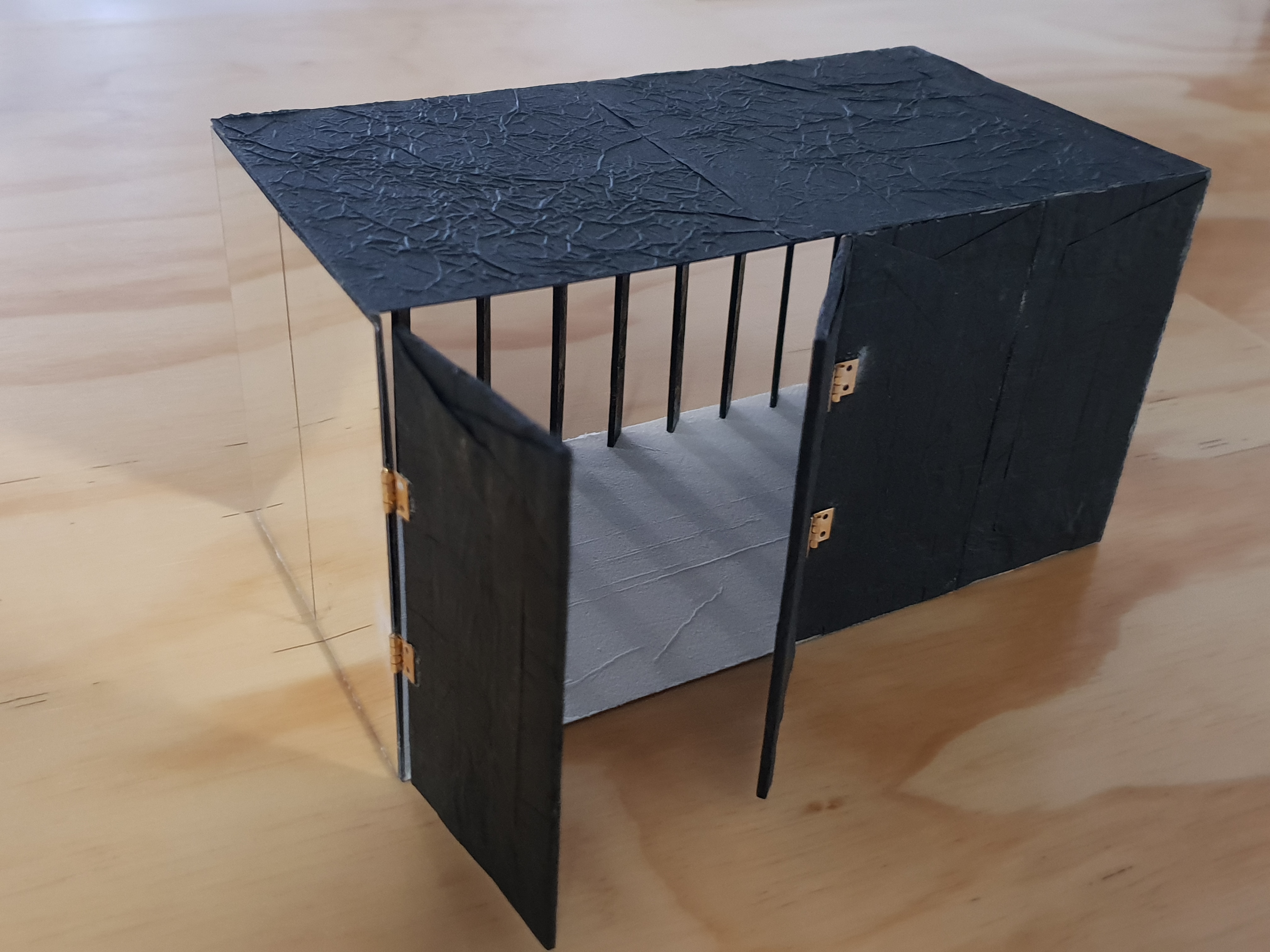
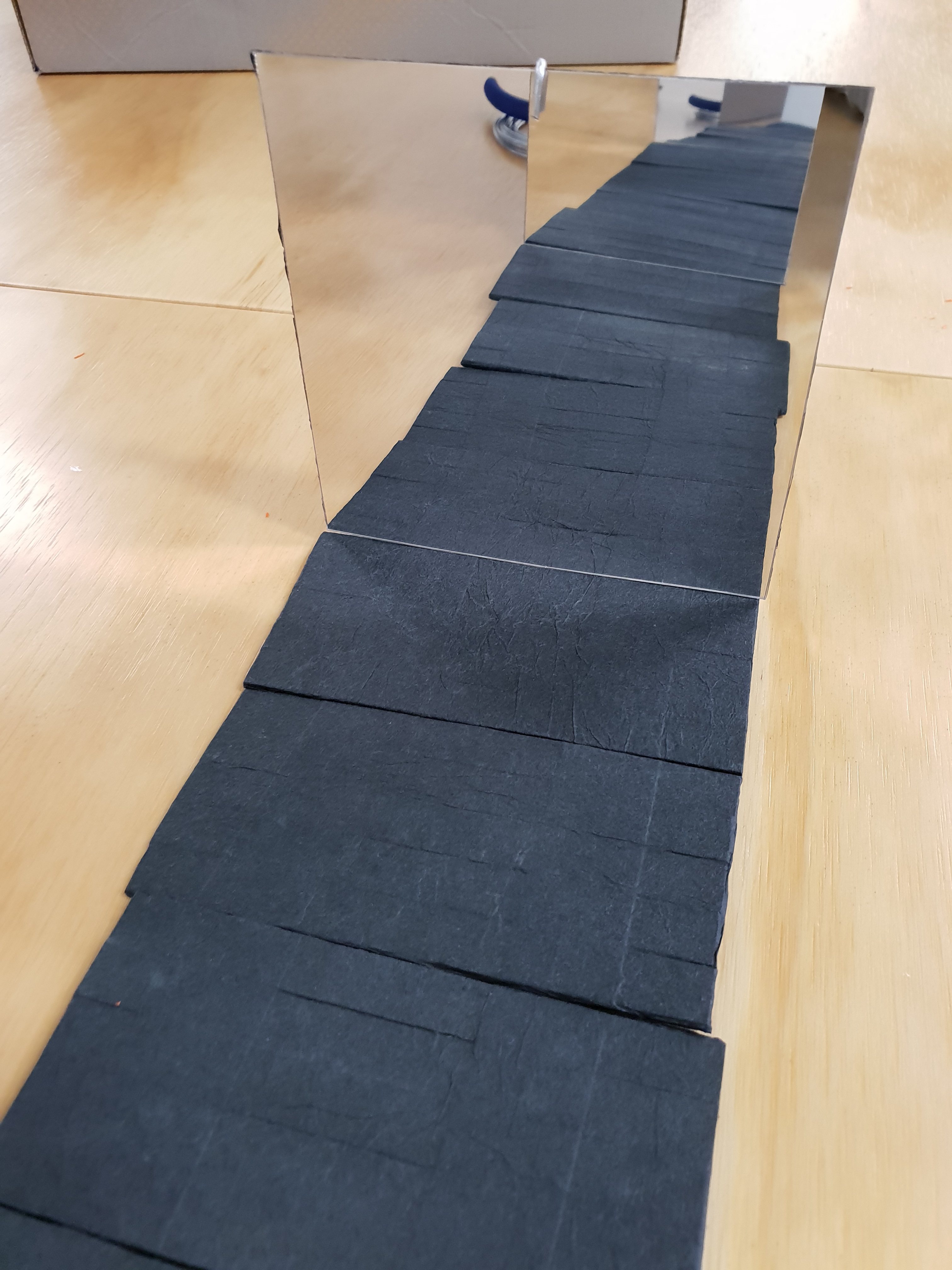
There are two doors on the back of the model to give a better view of the inside of the model. Two planes are installed on each side which was an idea driven from the start of the development stage. The mirrors create an infinite tunnel inside the model.

A test shot of the shadow inside the model was taken upon completion of the model. A lattice of light is formed as the light reflects on the mirror. In that the light represents different dreams, the intersection of light suggests merging and interaction of dreams.

Project 1: Atmospheric Model Making II

Week 2 Tues-Wed 05-06/03/19

Key Ideas:

  • Duality of dream – not only a portrayal of one’s mind/imagination but also originates from everyday life.
  • Coexistence of light and dark – both being influential

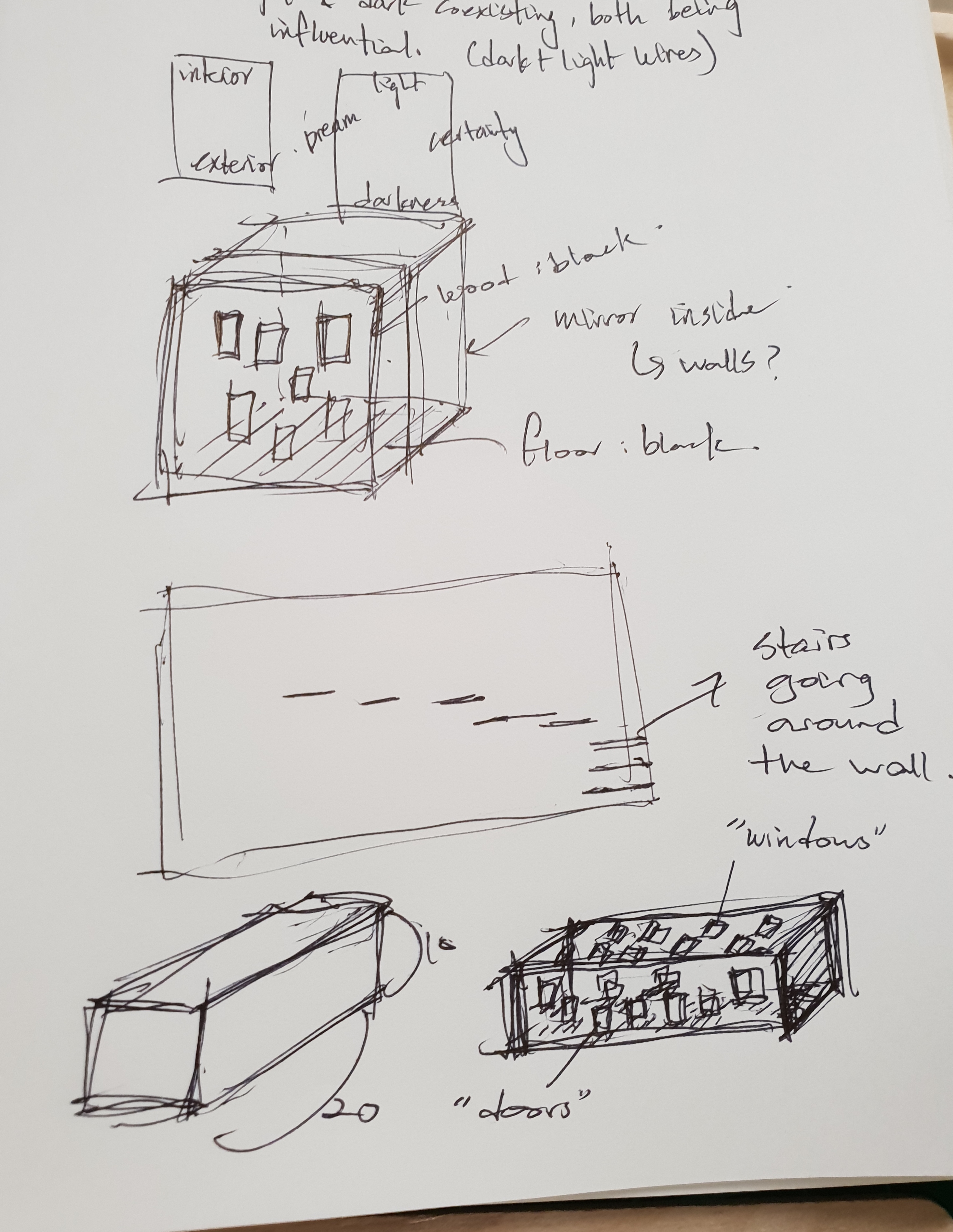
The initial idea was to generate a model similar to my drawing – with a plane in front with holes cut out so light can shine through and be reflected on the inner walls of the model. I decided to use mirror planes as a key element for my model to maximize and give variety to the light being reflected from the surface. My aim was to keep the colours and shapes from my drawing to have a common theme running through all pieces. (Refer to post Generating an A2 Drawing)

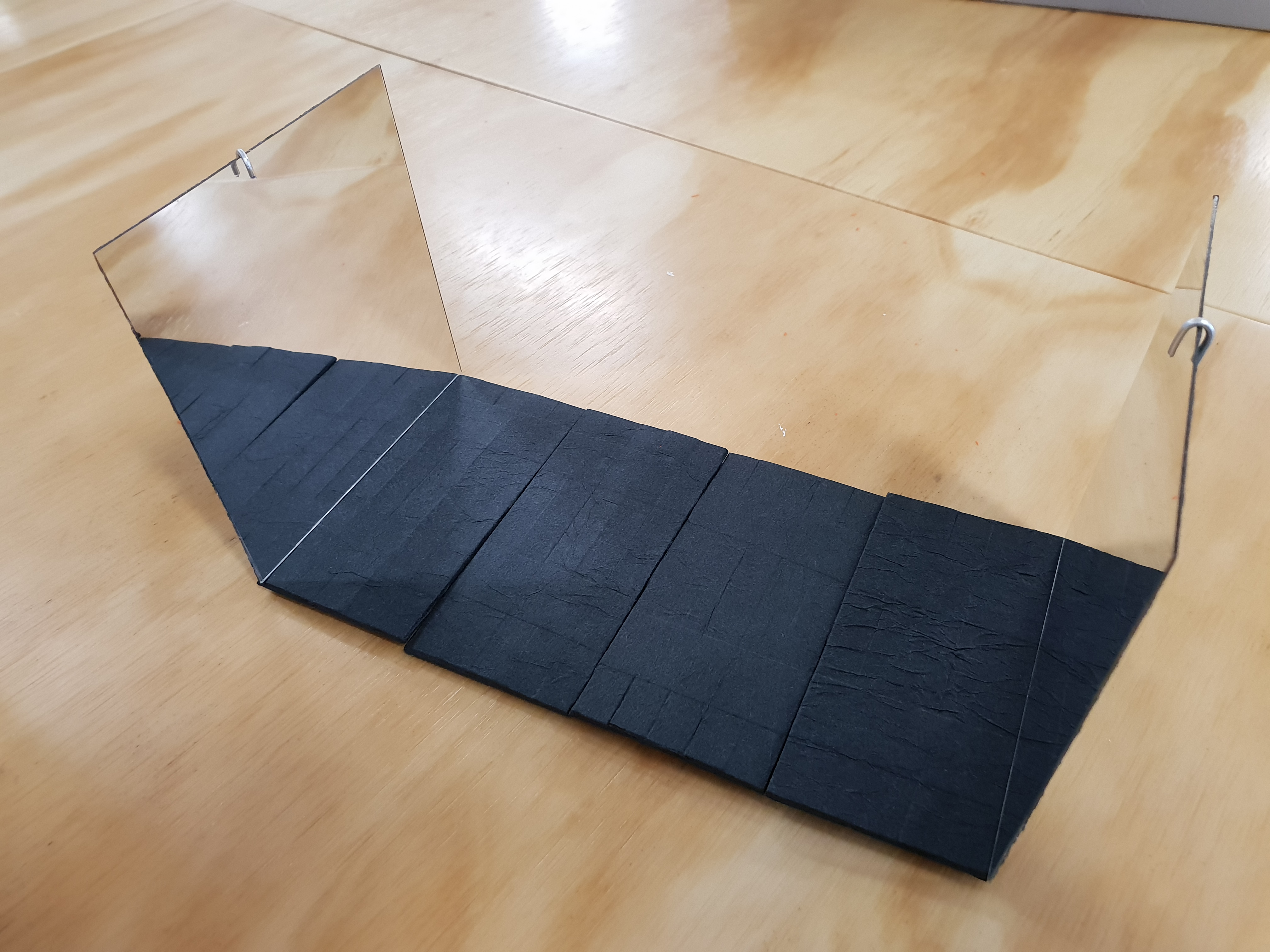
I started off by making the base which was made with wooden sticks and black wrapping paper, black symbolizing the night time when we dream. Wrapping paper was used in that the uneven texture of the wrapping paper replicates a surface that resembles a sheet of bedding or a blanket in the dark. (Same material was used to cover the back of the mirror planes as well.) While experimenting with the glass planes, I found out that the planes are hard to cut and are easily damaged, which meant I had to make changes to my initial plan. I wanted to experiment with reflections and light as much as possible. After a few experimental set-ups, I produced the base of my model.

I liked that an infinite reflection is created using the mirror planes on opposite sides, like a portrayal of infinite possibilities a dream has. After exploration, I tried replacing the floor with a glass plane and placed the wooden base around the bottom plane as walls.

Afterwards I covered the top of the model and took it out for a photo shoot. I was not satisfied with how the lights were being reflected inside the model and decided to take another approach in displaying the planes.

Project 1: Atmospheric Model Making I

Week 2 Mon 04/03/19

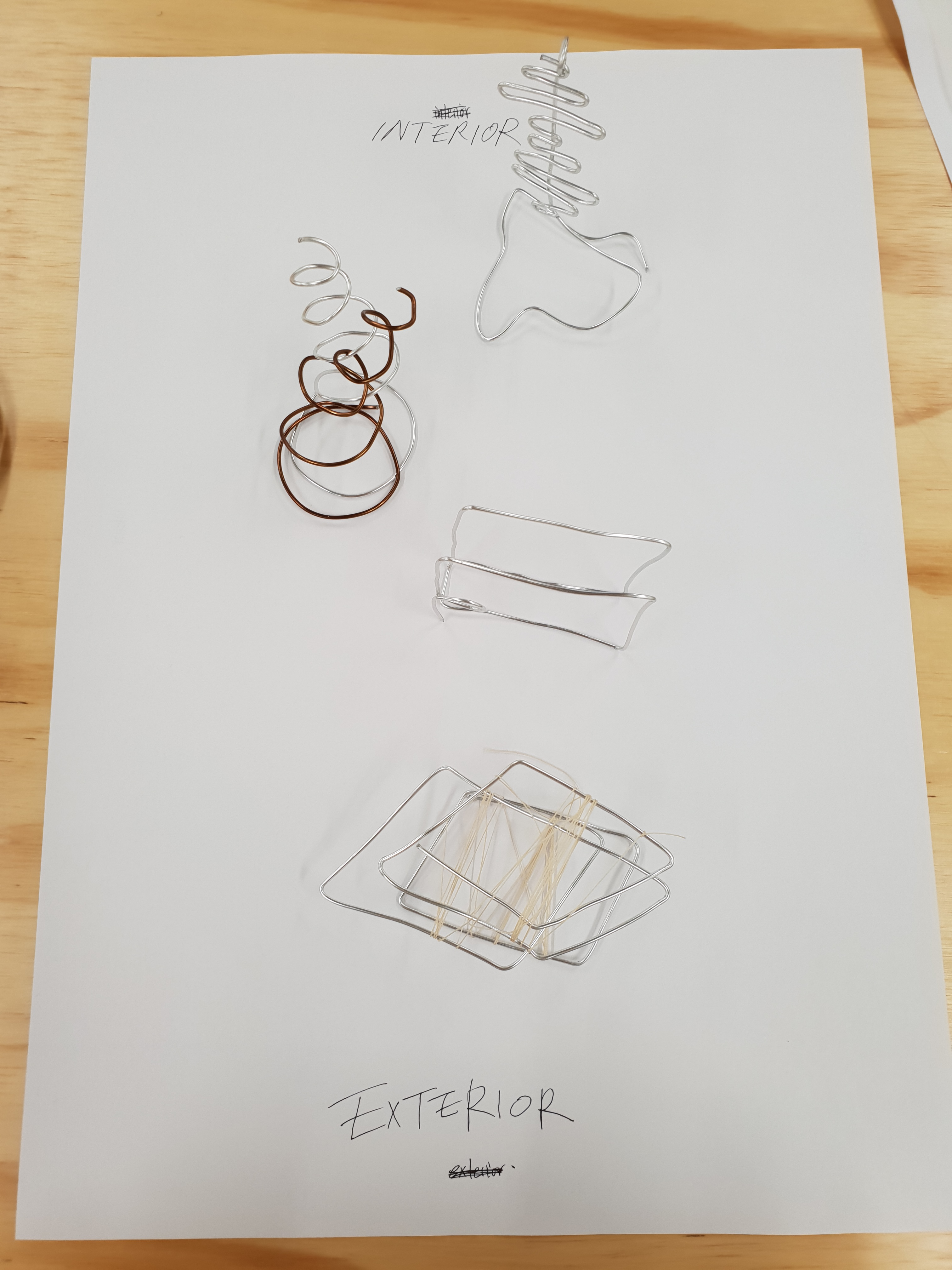
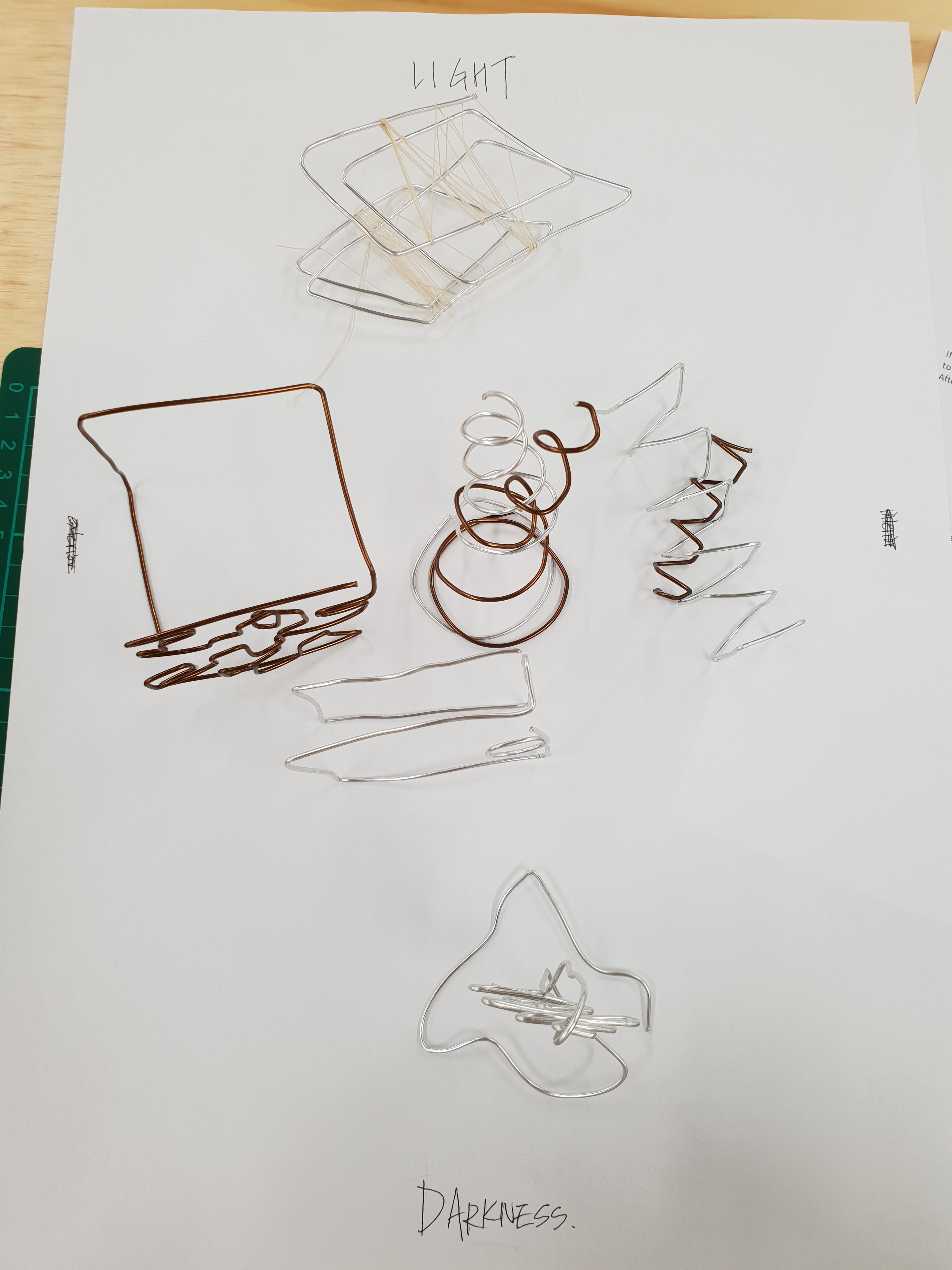
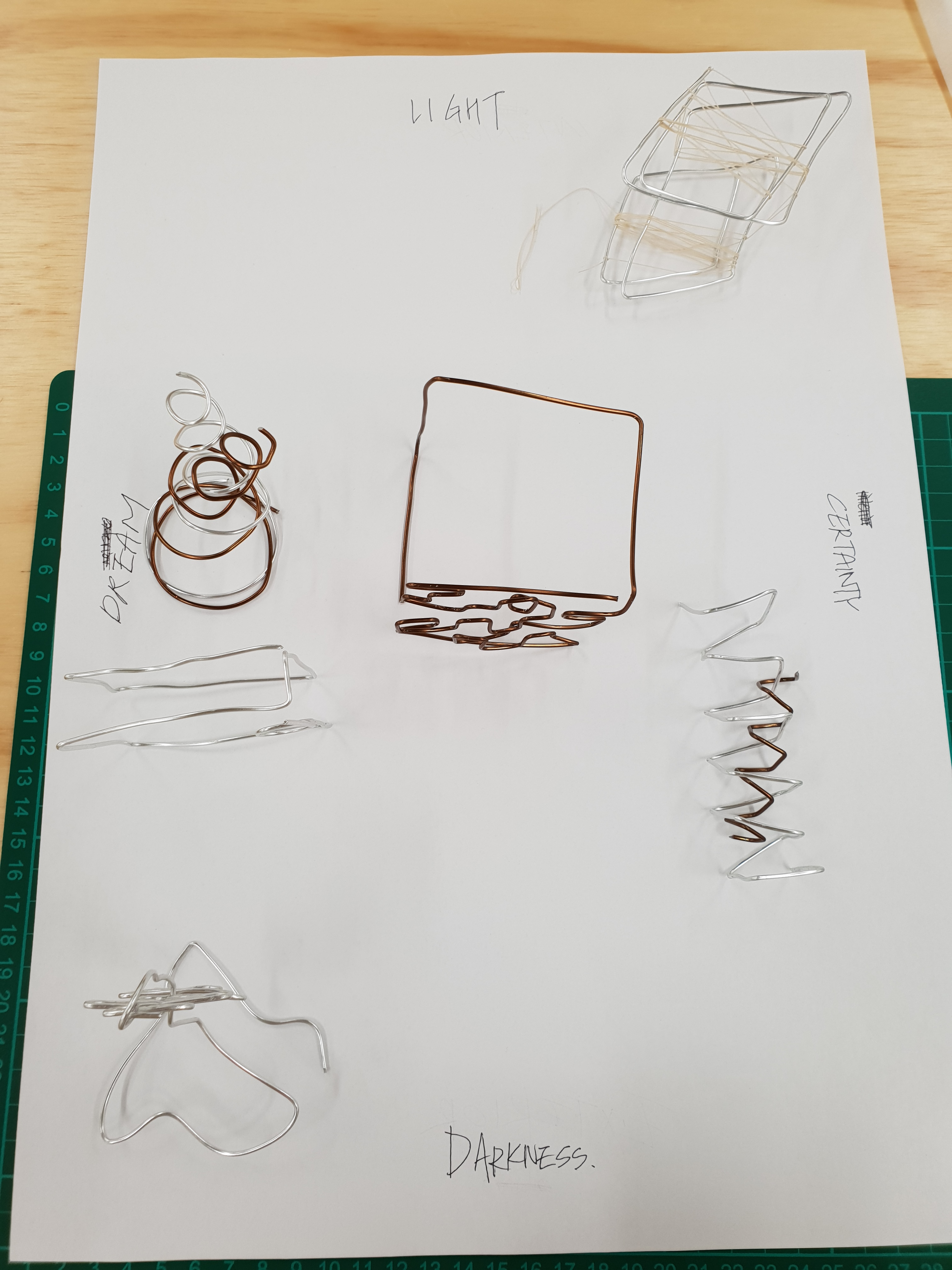
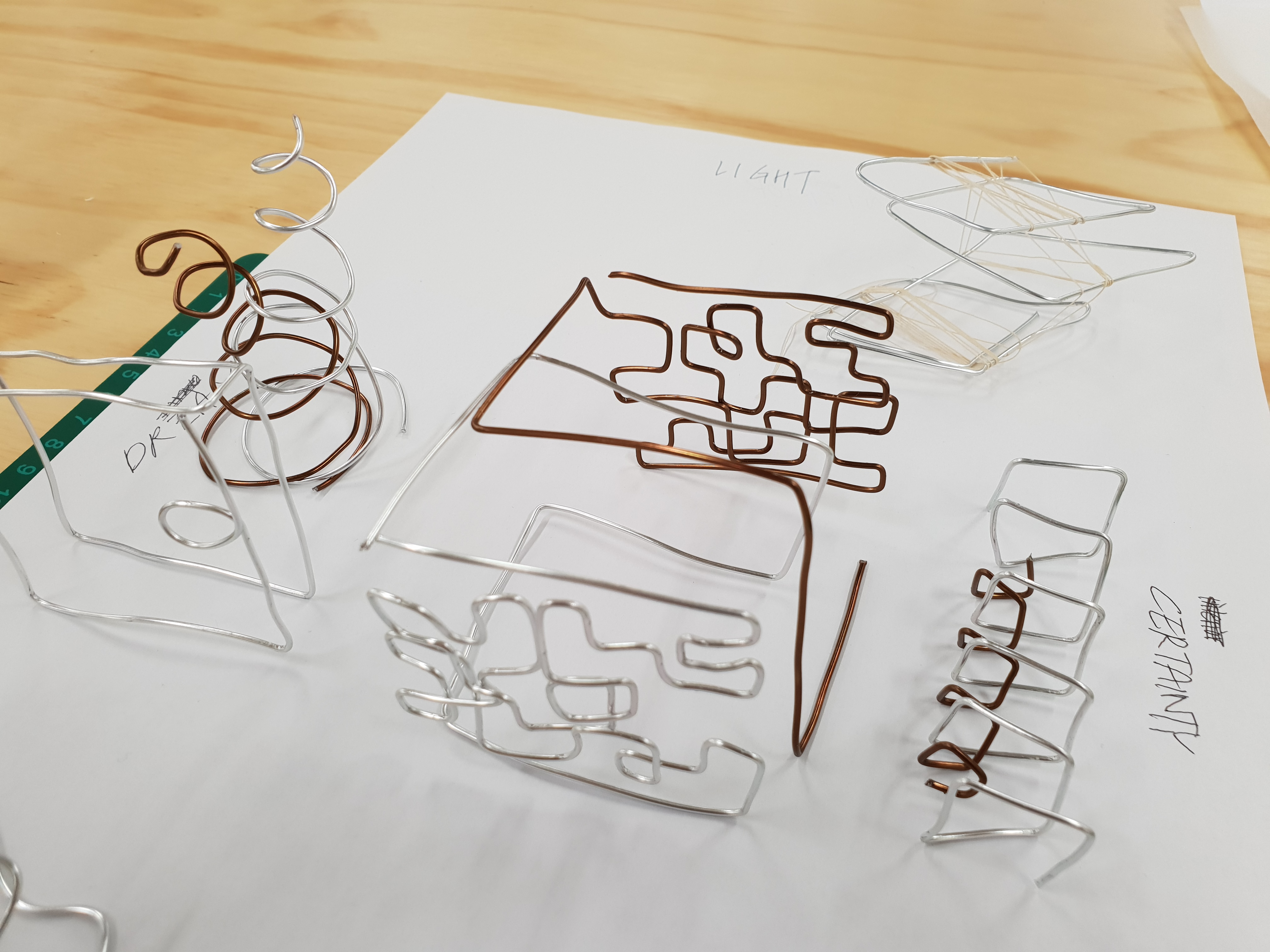
Quick wire models were produced in studio to explore various concepts through positioning the models on a labelled sheet of paper. Two colours of wires were used, often to represent light and dark. Lot of curves and squared patterns were used to explore the theme of sleep and wake.

Wire models placed in relation to concept of Interior (Top) and Exterior (Bottom)
Wire models placed in relation to concept of Light (Top) and Darkness (Bottom)

Wire models placed in relation to concept of Light (Top), Darkness (Bottom), Dream (Left) and Certainty (Right)

It was interesting to see a shift in position of models as other factors, dream and certainty, were placed onto the paper as well. The pieces central to the paper were those that connect dream and certainty together, thus were placed in the middle of the paper in that they are influenced by both day and night.
Towards the end of the session, I have generated two interlocking structures, one almost like a shadow of another, which I plan to develop further and incorporate into my actual model.

Interaction of two models